Article
AI-Powered Tools for Higher Education in 2027: Selection and Implementation Guide
November 11, 2026
5 Minute Read

Introduction
Artificial intelligence is becoming part of higher education workflows, from preparing course materials to handling administrative requests. Adopting AI tools for higher education does not, by itself, create institutional value. Universities need to determine whether a tool solves a specific problem, improves a measurable outcome, and can be supported responsibly over time.
For institutions planning 2027 higher education technology investments, the challenge extends beyond choosing new applications. They must assess how tools fit existing systems, what risks require oversight, and how to measure success. This guide walks through how to select, implement, and evaluate them.
AI in Higher Education: What to Expect in 2027
AI in higher education is moving beyond standalone applications toward capabilities embedded in learning management, student information, and administrative systems. Generative AI assistants can support instructional preparation, information retrieval, and routine communications, while analytics applications can identify patterns in student engagement and institutional operations.
Effectiveness still depends on reliable data, sound integration, and clear operational boundaries. As AI becomes part of established campus systems, institutions need to know who controls the information these tools use, how outputs are checked, and when staff must intervene. For 2027, that means looking closely at vendor accuracy, data handling, accessibility, interoperability, and contract terms.
Identify Institutional Needs Before Choosing AI Tools
Choosing AI tools for higher education starts with an institutional problem, not a product catalog. Universities should establish the process requiring improvement, the affected users, current performance, available data, and measurable objectives. That tells them whether AI is necessary at all or whether workflow, staffing, or system changes would do the job. Each project also needs an owner after launch, because even a promising tool becomes another system nobody maintains when responsibility is unclear.
Consider an admissions office that is slow to answer routine applicant inquiries. Before buying a chatbot, the institution should examine inquiry volumes, response times, recurring questions, and escalation needs. Success might then be measured through faster responses and better application completion. Institutions should also consider how individual improvements affect the broader AI-powered higher education learner journey, since these requirements will guide vendor evaluation and pilots.
Key AI Tools and Applications in Higher Education
AI Tools for Teaching and Learning
AI tools for teaching and learning can support instructional preparation, course-specific tutoring, formative feedback, and assessment development. Faculty can use them to draft learning activities, develop practice questions, and spot gaps between learning objectives and assessments. Faculty still need to check generated materials for accuracy, accessibility, and relevance to the course.
The University of Texas at Austin's UT Sage illustrates a faculty-guided approach. Instructors can build course-specific tutors by defining learning outcomes and uploading resources that the tutor uses as its primary source. Institutions evaluating AI assessment tools for educators should weigh assessment validity, feedback quality, and educator oversight.
AI Tools for Admissions and Enrollment
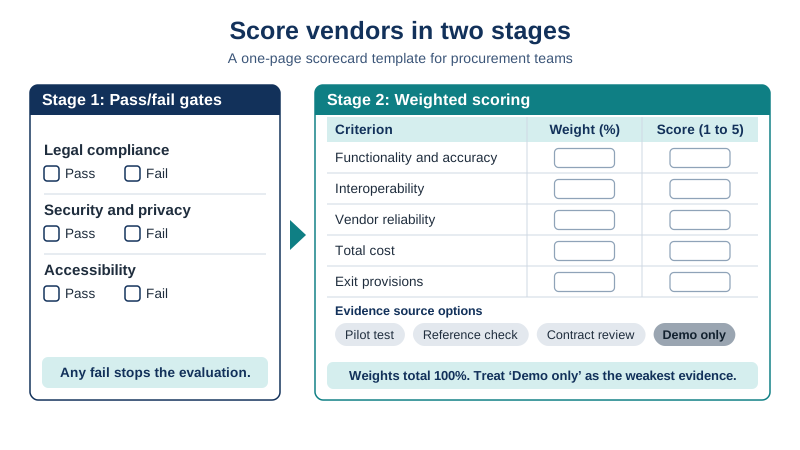
Admissions teams handle large volumes of inquiries about application requirements, deadlines, documentation, and financial aid. AI assistants can provide routine information, flag incomplete administrative steps, classify inquiries, and direct applicants to appropriate staff. AI chatbots for application support can help institutions provide timely guidance during periods of high application activity.
Universities must still distinguish administrative assistance from consequential decisions. Applications that influence eligibility, selection, or financial aid determinations require added scrutiny for fairness, accuracy, transparency, and human oversight.
AI Tools for Student Support and Success
AI tools for student support can help students obtain information about registration, academic procedures, campus services, and administrative requirements. Self-service applications can answer routine questions, classify requests, and direct complex cases to qualified staff. Institutions considering AI self-service in higher education should define which interactions suit automation and which require human intervention.
Faster responses do not automatically demonstrate better student success, whether measured by retention or academic performance. Universities should measure operational efficiency separately from longer-term educational outcomes.
AI Tools for University Operations
Administrative departments can use AI for document classification, information extraction, knowledge retrieval, and workflow automation. Examples include processing routine forms, retrieving institutional policies, organizing support requests, and drafting administrative communications. These systems depend on accurate information from authoritative sources, and an assistant relying on outdated policies or incomplete records creates extra work instead of saving it. Institutions should evaluate integration with existing systems, data access permissions, audit trails, and procedures for correcting inaccurate outputs.
How to Evaluate AI Tools for Higher Education
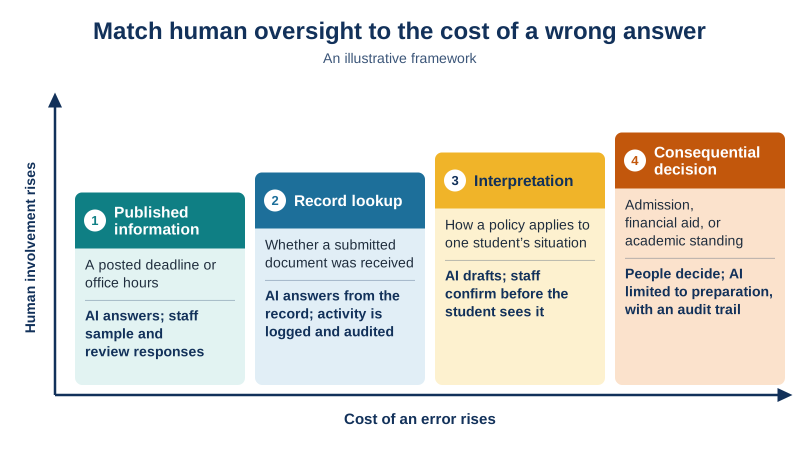
Selecting AI tools for higher education requires a structured evaluation that weighs institutional requirements against vendor capabilities. These criteria give procurement teams a practical basis for comparison.
- Functionality and accuracy: Does it perform reliably on representative institutional tasks?
- Privacy and security: Where is data stored, retained, or used for model training?
- Accessibility: Has the interface been tested with assistive technologies?
- Interoperability: Can it connect to LMS, SIS, CRM, and identity systems?
- Vendor reliability: What support, performance evidence, and service commitments are available?
- Total cost: What will licensing, integration, training, and ongoing usage cost?
- Exit provisions: Can the institution retrieve its data and migrate without undue disruption?
A polished vendor demonstration is not enough. Universities should test shortlisted tools against the questions, documents, and exceptions their teams handle every day. Legal compliance, security, and accessibility should be treated as essential conditions, because strong functionality cannot offset unacceptable risk in these areas.
Institutions must also decide whether to buy an existing application, configure current software, extend an established platform, or build a custom solution, depending on requirements, resources, and long-term costs. External providers of AI solutions for education can support evaluation and implementation where additional expertise is needed.
How to Implement AI Tools in Higher Education
Assess Institutional Readiness
Sound AI implementation in higher education begins with readiness. Before deployment, institutions should evaluate the quality and availability of relevant data, integration capabilities, security requirements, and existing AI policies. They should identify authoritative information sources and assign responsibility for maintaining them. IT teams must assess authentication, access permissions, APIs, monitoring, and incident response. Organizational readiness matters too, since faculty and staff need time, guidance, and support to take part in testing and oversight.
Start With a Focused AI Pilot
A focused pilot lets institutions evaluate performance without committing to campus-wide deployment. It should address a defined use case, involve a manageable user group, and run within a set timeframe. Before launch, teams should document baseline performance, success criteria, data permissions, and human escalation procedures. For example, an institution could test an AI assistant for routine admissions inquiries within one department, examining response accuracy, resolution time, applicant satisfaction, and how often staff must intervene.
Stopping conditions should be set in advance for unacceptable errors, privacy incidents, or accessibility problems. Institutions planning AI-powered student support operations can pilot one category of student requests before introducing more complex services.
Review Pilot Results Before Expanding
Pilot outcomes should be compared with the objectives set before deployment, covering technical reliability, operational improvement, user experience, accessibility, and unexpected problems. Reviewing unsuccessful interactions can expose weaknesses that overall satisfaction scores conceal. The team can then make a clear decision: expand, adjust, retest, or stop. A successful pilot does not guarantee readiness for wider deployment, because additional users, integrations, and requirements can introduce new risks.
Prepare Teams and Set Clear Responsibilities
Responsibilities should be assigned before deployment. Faculty oversee instructional appropriateness and academic quality, IT teams manage integration, security, and monitoring, and data stewards maintain information quality and access permissions. Operational teams run daily workflows, escalation, and service performance, while institutional leaders set priorities, allocate resources, and approve risk-related decisions.
Responsible AI Use: Privacy, Governance, and Academic Integrity
Responsible AI in higher education requires governance proportionate to each application's intended use and potential consequences. In the United States, institutions covered by the Family Educational Rights and Privacy Act (FERPA) must consider its requirements when AI systems process education records. The General Data Protection Regulation (GDPR) applies only where an institution's activities fall within its territorial scope, and neither law applies identically to every institution.
The European Union's AI Act sets requirements for specified high-risk uses, including certain education-related applications. Regulation (EU) 2026/1744, in force since July 27, 2026, moved the date for requirements covering systems classified as high-risk under Article 6(2) and Annex III to December 2, 2027. Not every educational AI application falls into that category, so institutions must assess intended purpose, data involved, and the consequences of automated decisions.
The NIST AI Risk Management Framework and its Generative AI Profile offer voluntary guidance for identifying and managing AI-related risks. Effective AI governance in higher education should also address academic integrity, accessibility, transparency, human oversight, incident reporting, and periodic reassessment. Policies should specify what happens when an AI recommendation conflicts with an institutional record, and who has authority to correct or override it.
Preparing Faculty, Staff, and Students to Use AI Tools
AI literacy should reflect the responsibilities of different users. Faculty need guidance on instructional applications, assessment design, verifying generated materials, and academic integrity expectations. Administrative staff should understand data handling restrictions, system limitations, escalation procedures, and how to spot inaccurate outputs. Students need clear instructions on acceptable use, disclosure requirements, independent verification, and how to report concerns.
Training works best with practical examples rather than a tour of tool features. Faculty development teams can use AI content tools for educators in guided exercises that practice verifying and adapting generated instructional materials. Someone also needs to own the job of updating guidance as technologies and policies change.
How to Measure the Success of AI Tools in Higher Education
AI investment decisions require measurement across several dimensions. Technical performance includes accuracy, reliability, response times, and error rates, while operational improvement covers inquiry resolution, workflow completion, processing times, and staff workload. Educational outcomes such as learning progress, satisfaction, persistence, or completion belong in the picture only where evidence supports a connection to the intervention. Accessibility and equity assessments should examine whether applications serve different user groups consistently.
Financial performance compares quantifiable benefits with implementation and operating costs. A basic ROI calculation is:
ROI (%) = [(Quantified financial benefits − Total costs) ÷ Total costs] × 100
Staff time saved through automation does not automatically reduce expenditure, because financial benefits depend on how recovered capacity is used. A useful dashboard compares baseline performance, pilot results, and ongoing costs. Chatbot usage or the volume of generated output should not be treated as evidence of educational benefit.
Conclusion: Choosing the Right AI Tools for 2027
Universities should begin with clearly defined needs, evaluate solutions against practical requirements, test before wider deployment, and put governance in place. The goal is to choose AI tools for higher education that improve educational quality and operational effectiveness, with measurable value and clear accountability.
FAQs
AI-powered tools for higher education are software applications that use machine learning or generative AI to support academic and administrative work on campus. Examples include tutoring assistants, assessment support applications, admissions chatbots, student service tools, document processing systems, and institutional analytics platforms.
References
- The University of Texas at Austin. UT Sage. https://provost.utexas.edu/the-office/academic-affairs/office-of-academic-technology/ut-sage/
- European Union. Regulation (EU) 2026/1744 (Digital Omnibus on AI), amending Regulation (EU) 2024/1689. https://eur-lex.europa.eu/eli/reg/2026/1744/oj
- NIST. Artificial Intelligence Risk Management Framework (AI RMF 1.0), NIST AI 100-1. https://doi.org/10.6028/NIST.AI.100-1
- NIST. Artificial Intelligence Risk Management Framework: Generative Artificial Intelligence Profile, NIST AI 600-1. https://doi.org/10.6028/NIST.AI.600-1
About the Author

SVP, Advanced Digital Solutions
A results-driven professional with comprehensive experience working in global and cross-cultural environments. Possesses extensive experience in F&A operations, customer relations, financial, market and economic analysis, and advisory services, complemented by a strong educational foundation. Demonstrates expertise in establishing productive relationships with diverse clients by driving operational rigor and excellence, supported by process improvements and efficiency gains, along with a proven record of successfully leading multiple and diverse engagements.
Share with Friends:






Related Insights
From industry research to thought-provoking articles and podcasts, we bring you insights into our fast-evolving world of education technology. Come learn and evolve with us.
We discuss the paradox students face when using generative AI tools like ChatGPT, and how educators can foster authentic learning experiences in an AI-driven world.
Read More
Through our work impacting 10 million learners nationwide with innovative K-12 and Higher Education solutions, we bring insights from the front lines of digital education.
Read More
GCCs have reputation for efficiency, and they’re quickly becoming a business advantage in the EdTech industry where speed defines success.
Read MoreLet's have a conversation...
For over twenty years, LearningMate has been leading the charge in large-scale education technology innovation. To learn more about our AI-enabled solutions and our human-in-the-loop approach to AI, contact us.

