Article
AI-Powered Communication in Student Support Services: Consistency, Quality & Personalization
November 9, 2026
5 Minute Read

Student Support Communication Is a Student Experience Strategy
AI is already familiar to university students. Dependable institutional communication has not always kept pace. According to a 2026 survey by the Higher Education Policy Institute (HEPI), 95% of surveyed U.K. undergraduates had used AI in at least one way, while 49% believed it had improved their student experience. The research examines AI use broadly, not university support systems specifically. Still, it raises an uncomfortable question: when students can obtain an explanation from AI in seconds, why can getting a clear answer from their university still involve multiple offices and conflicting instructions?
Consider what happens when a student wants to withdraw from a course mid-semester. The registrar can explain the deadline, but the decision may also affect financial aid eligibility and progress toward graduation. Each department may provide accurate guidance within its own responsibilities without explaining how the different requirements fit together. The student is left to connect the dots, often when the decision is time-sensitive.
AI-powered communication in student support should be judged by whether it helps students resolve these connected problems, not by how quickly a chatbot replies. That calls for consistent institutional guidance, actionable answers for students, and personalization that respects privacy and access boundaries. It also requires keeping qualified professionals responsible for decisions that demand human judgment.
Why Student Support Communication Breaks Down
Students experience a university as one institution. Behind the scenes, however, their questions may pass through several departments, each with different systems, policies, and responsibilities. A registration problem can involve the registrar, the financial aid office, the academic advisor, and the student accounts team. What appears to be one question from the student’s perspective may require several offices to coordinate before it can be resolved.
A connected student journey depends on departments coordinating their guidance. The difficulty is not always that departments provide incorrect answers. Often, they provide only part of the answer. A financial aid officer may correctly explain the documentation required to maintain eligibility, while an academic advisor focuses on course selection. Neither response necessarily addresses the administrative steps connecting those decisions.
The information students need is also scattered. Universities maintain academic catalogs, departmental websites, policy manuals, student portals, internal knowledge repositories, and service desk records. A policy change may be reflected on the registrar’s website before it appears in an advising knowledge base or an automated email template. Students encountering different versions of the same instruction have little reason to know which one is authoritative.
Adding another communication channel does not resolve this fragmentation. A chatbot connected to outdated documents may answer questions faster while reproducing the same inconsistencies. Automated reminders can create further confusion when they reach students who have already completed a requirement. And when a complex inquiry moves between departments without its history, students must explain the problem again.
For university leaders, the question is therefore not simply how to respond to more inquiries with fewer manual steps. It is about ensuring that information remains accurate, that responsibility is clear, and that students can move from receiving an answer to completing the task that prompted the inquiry.
What AI-Powered Student Communication Means
AI-powered communication goes beyond simply adding a conversational interface to a university website. It combines language understanding, access to approved institutional information, and defined service workflows to help students navigate administrative processes.
Take a student asking, “I submitted my financial aid documents last week. Why am I still receiving reminders?” A basic chatbot might repeat the reminder or provide a link to the financial aid portal. A more capable system, operating with appropriate authorization, could distinguish between a general question about verification and an inquiry that requires access to an individual's submission status. It could explain the relevant process, identify any missing information, or direct the student to the team responsible for reviewing the record.
This is where AI communication for student services becomes more useful than automated question answering. Depending on the institution’s systems and permissions, AI can retrieve policy guidance, classify inquiries, prepare case summaries, draft staff responses, and support predefined service actions. The system should also recognize when the information available is insufficient to provide a reliable answer.
Retrieval-augmented generation (RAG) is one way to connect a language model to approved institutional knowledge. Rather than relying only on information learned during model training, the system retrieves relevant material from designated sources and uses it to construct a response. But retrieval is not a substitute for sound information management. If the source document is outdated, incomplete, or inconsistent with another policy, the resulting answer may still be wrong.
The distinction between information and action matters just as much. Explaining how to remove a registration hold is different from checking whether a particular student has one. Removing that hold is another matter entirely. Each step requires its own permissions, system controls, and institutional authority.
AI-powered communication in student support works best when these boundaries are explicit. Students should receive useful guidance without having to understand the underlying technology, while staff and administrators retain control over what the system can access, recommend, and execute.
The Three Pillars: Consistency, Quality, and Personalization
Consistency, quality, and personalization form the foundation of effective AI-supported student communication. Each addresses a different institutional challenge, from maintaining authoritative guidance across departments to helping students act on information while respecting their privacy.
These priorities must work together. A consistent answer may still be incomplete, while a personalized response can introduce privacy risks if access controls are inadequate. The framework below illustrates how the three dimensions complement one another.
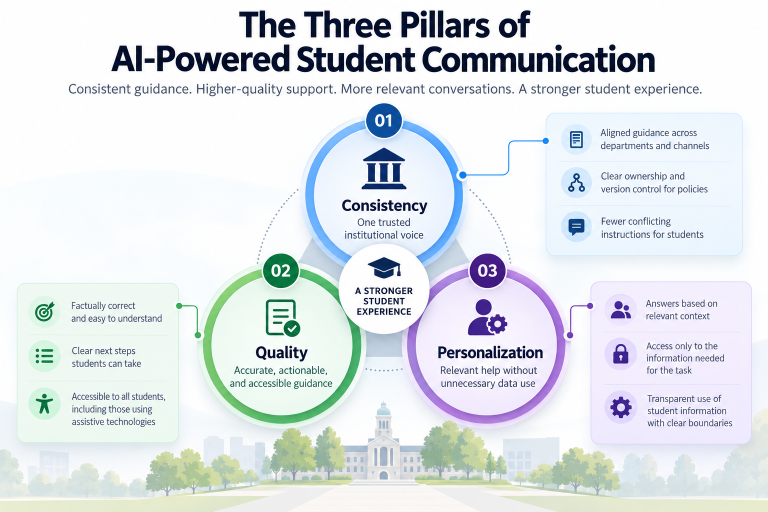
Consistency: One trusted institutional voice
A university cannot promise consistent answers if the registrar, financial aid office, and student services team are working from different versions of the same policy. Connecting an AI assistant to all three sources does not solve the problem. It simply gives the system more conflicting information to draw from.
The practical starting point is to decide which office owns each policy, how changes are approved, and which related instructions must be updated when a rule changes. If the registrar revises a withdrawal deadline, the institution needs to check the guidance students receive via the portal, email, the service desk, and any AI-supported channels. Exceptions must also be clearly recorded so students are not given a standard answer when a different rule applies.
This does not mean every department must abandon its own knowledge repository. Different systems can remain in place as long as the institution identifies authoritative sources and establishes a reliable process for resolving conflicts. Staff also need a way to flag incorrect guidance so that problems can be corrected at the source rather than repeatedly addressed in individual conversations. Consistency is not something an AI system can establish on its own. It is an institutional decision that technology can help enforce.
Quality: Accurate, actionable, and accessible guidance
A technically correct answer can still leave a student stranded. Telling someone that a financial aid appeal is permitted under institutional policy offers limited help if the response does not explain where to find the form, which documents are required, or how the review process works.
Quality begins with accuracy but extends to what the student can do with the information. An effective response should explain the relevant requirement in plain language, identify the next appropriate action, and distinguish confirmed information from matters requiring further review. When the answer depends on missing records or an unresolved policy question, the system should acknowledge that limitation rather than fill the gap with an assumption.
Accessibility is part of that obligation. The World Wide Web Consortium’s Web Content Accessibility Guidelines (WCAG) 2.2 provide a recognized framework for evaluating accessible digital experiences. Universities should assess the complete support process, including keyboard navigation, compatibility with assistive technologies, forms, error messages, and transitions between systems. An accessible chatbot offers little practical value if the form it directs students to cannot be completed using their assistive technology.
Quality also needs continuous review. Universities can test representative student questions against approved policies, examine cases in which students repeatedly request clarification, and identify responses that led to unnecessary transfers. These findings can reveal problems in the AI system, but they can also expose confusing institutional instructions that need to be rewritten. The objective is not to produce longer answers. It is to provide the right information in a form that helps students move forward.
Personalization: Relevant help without unnecessary data use
Personalized student communication should make an interaction more relevant, not more intrusive. If a student asks about a library fine, the system does not need access to their financial aid history. If the question concerns an outstanding tuition balance, authenticated access to the appropriate account information may be necessary.
The distinction sounds straightforward, but it becomes important when universities connect conversational tools to student information systems, CRM platforms, and service records. Technical access to a database does not automatically justify using every field it contains. The information retrieved should match the purpose of the interaction and the permissions associated with the student or staff member.
Consider an advisor preparing for an appointment about graduation requirements. A staff-facing assistant might help retrieve relevant degree requirements and summarize authorized academic information. A public-facing assistant answering a general question about commencement dates needs none of that personal context. Both interactions can be useful without relying on the same data.
Universities should also make clear when students are receiving general guidance and when a response is based on authenticated records. Personalization becomes more trustworthy when students understand the information being used and can reach a person if the context is incorrect or incomplete.
The goal is not to make every response feel individually tailored. It is to ensure that the guidance fits the question while keeping access to student information proportionate to the task at hand.
AI Communication Use Cases Across Student Services
The best starting points for AI communication for student services are not necessarily the most technologically ambitious. They are processes in which students repeatedly encounter unclear instructions, unnecessary handoffs, or difficulty finding up-to-date information. Registration, financial aid, onboarding, academic advising, campus services, and case management offer practical opportunities to address these problems.
Registration and academic records. Students need help understanding enrollment windows, course withdrawal procedures, transcript requests, graduation applications, and registration restrictions. AI can explain published requirements and, where authorized integrations are available, help students interpret an account's status. Requests involving academic exceptions or changes to official records should follow established approval processes.
Financial aid and student accounts. Questions about verification documents, payment schedules, application procedures, and published eligibility requirements can consume significant staff attention. AI can organize these instructions into clearer steps and help route inquiries that require individual assessment. The system should not independently decide appeals, resolve disputed balances, or make financial aid determinations.
Orientation and onboarding. New students may need to complete tasks related to identity verification, access to technology, enrollment documentation, academic preparation, and campus services. An AI-supported interface can explain the sequence of requirements and help students locate the right office when a task cannot be completed.
Academic advising. Students often seek clarification on degree requirements, prerequisites, course-planning terminology, and advising procedures. AI can retrieve approved academic information and help students prepare for appointments, allowing advisors to focus on individual circumstances and decisions that require professional judgment.
Campus services and student affairs. Housing procedures, campus facilities, career services, and routine administrative questions can be supported through accessible self-service guidance. Sensitive requests involving accommodations, welfare concerns, or personal safety need appropriately designed pathways to qualified staff.
Service desk and case management. AI can help identify the subject of an inquiry, prepare a summary of relevant correspondence, and direct the request to the responsible team. When cases move between departments, a useful summary can reduce the need for students to repeat information, provided the receiving staff member has permission to view it.
For student services leaders, the choice of use case should reflect more than inquiry volume. A frequently asked question with a stable, published answer is different from an issue involving conflicting records or a decision that could affect a student’s academic standing.
AI self-service in higher education is a practical starting point for well-defined requests. Institutions can test whether students complete the associated tasks and expand only when the underlying information and workflows are dependable. The purpose of automation is to remove avoidable friction, not to push complicated cases into a channel that cannot resolve them.
How AI Supports Staff Without Replacing Them
The most useful role for AI in student support may be less visible to students than the chatbot on a university homepage. Much of the work happens before a staff member sends a response: locating policies, reviewing previous correspondence, checking records, and determining which office has authority to act.
Consider an inquiry that has already passed through financial aid and academic advising. Before the next staff member can respond, they may need to reconstruct the case from several messages and systems. AI communication for student services can help organize this history, retrieve relevant guidance, and prepare a summary for verification. This approach can contribute to reducing administrative backlog with AI agents, provided staff can verify the summaries. The professional can then focus on identifying the unresolved issue rather than restarting the search for information.
AI can support this preparation, but the quality of the result depends on what the system can legitimately access and how accurately it interprets the records. A summary that omits an important exchange or presents an assumption as fact may create additional work. Staff must be able to inspect the underlying information, correct the output, and decide whether the suggested response is appropriate.
Human-in-the-loop AI should therefore be more than a requirement to click an approval button. Staff need meaningful authority to challenge recommendations, correct source material, and identify cases that should not be handled automatically. They also need training that explains the system’s limitations and the procedures for reporting errors.
This raises an important management question: is AI genuinely reducing administrative effort, or simply shifting that effort to reviewing generated material? Institutions should examine how much time employees spend verifying outputs, correcting mistakes, and handling cases that were routed incorrectly.
The aim is not to remove professionals from student support. It is to reduce unnecessary information gathering so that they can devote more attention to interpretation, coordination, and individual circumstances.
Building the Knowledge, Data, and Workflow Foundation for AI Student Communication
A university can deploy an impressive conversational interface and still struggle to answer a basic student question. If the underlying policy is outdated, the relevant system is inaccessible, or no department owns the next step, the interface cannot compensate for those weaknesses.
Before adopting AI services for education, institutional leaders need to examine three foundations: the reliability of their knowledge, the connections between their systems, and the rules governing what happens after a question is understood.
Trusted knowledge content
Every policy used by an AI system needs a source that the institution recognizes as authoritative. That sounds simple until a deadline appears in an academic catalog, a departmental webpage, a downloadable handbook, and an internal service desk article, each maintained by a different team.
The solution begins with ownership. Departments need to know which documents they are responsible for, who approves changes, and which related materials must be reviewed when a policy is updated. Where a rule affects several offices, those dependencies should be made explicit rather than left for students or support staff to discover.
Institutions also need to distinguish current guidance from drafts, historical policies, and internal documents that should not be presented to students. Retrieval systems can be configured to prioritize approved sources, but content owners must still verify that the information remains valid.
A practical test is to ask what happens after a policy changes. Can the institution identify all affected knowledge sources, update the relevant guidance, and verify whether the AI continues to return an obsolete answer? If not, the knowledge-management process needs attention before automation expands.
Connected systems
Universities rarely operate from a single student database. Student information systems (SIS), customer relationship management (CRM) platforms, learning management systems (LMS), and case-management applications serve different purposes. Students may need information from more than one system to resolve an issue, but that does not mean every application should have unrestricted access to all of them.
A student-facing assistant might be authorized to display the status of a submitted document after authentication. A staff-facing tool may need additional information to investigate why the document has not been processed. Changing the official record, however, may require a separate workflow and explicit approval.
These distinctions should be reflected in the integration architecture. Secure APIs, identity controls, role-based permissions, and audit logs can help limit access and establish a record of authorized actions. Institutions must also review the security and contractual arrangements associated with third-party technology providers.
The goal is not to connect every system simply because integration is technically possible. It is to connect the information and functions necessary for defined student support tasks.
Workflow rules and permissions
Understanding a student’s question is only the beginning. The system must also know what it is permitted to do next. An AI assistant may explain the steps for appealing a grade, but the appeal itself belongs within the institution’s academic review process. It may display available advising appointments, but booking one requires an authorized scheduling function. It may identify a possible account discrepancy, but correcting the record requires the appropriate institutional authority.
These distinctions should be translated into explicit workflow rules. Institutions need to determine which requests can be answered automatically, which actions require authentication, which transactions require confirmation, and which cases must be routed to staff.
Rules also need to account for unavailable systems, missing information, and contradictory records. When an assistant cannot verify the information required to proceed, the correct outcome may be a clear explanation and a transfer to the responsible office.
A reliable student communication system is not one that attempts every task. It is one that recognizes the limits of its authority and helps the student reach the next appropriate step.
Human-in-the-Loop Escalation and Safeguards
Not every student inquiry belongs in an automated conversation. Some questions require a straightforward explanation; others involve conflicting records, policy exceptions, sensitive circumstances, or decisions that only authorized staff can make. The challenge for institutional leaders is to establish those boundaries before a difficult case reaches the system.
A question about a published payment deadline may be suitable for self-service. A student disputing an account balance needs a different process. If the same student explains that the unresolved charge is preventing registration, the issue may require coordination between student accounts and the registrar. Repeating the payment policy will not resolve the problem.
Straive LearningMate’s framework for AI student support operations distinguishes between AI self-service, AI-assisted case management, and human-led support, providing a model for routing student inquiries according to their complexity and need for professional judgment.
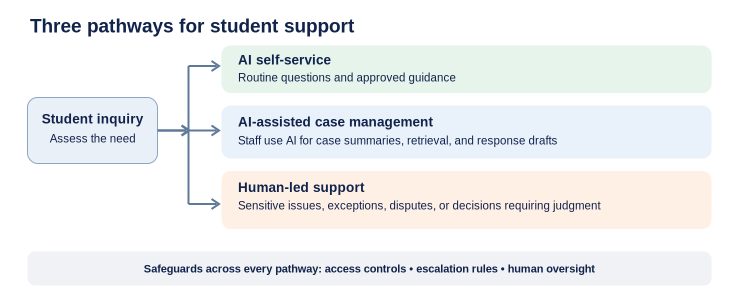
For AI communication for student services to support this workflow reliably, institutions need explicit escalation criteria and clearly assigned responsibilities. Missing or contradictory information, policy exceptions, repeated unsuccessful interactions, and requests for human assistance should trigger an appropriate handoff. Sensitive cases also require established procedures for reaching qualified professionals.
A good handoff does more than transfer a ticket. It provides the receiving professional with an appropriately limited summary of the student’s concern, the steps already taken, and the guidance previously supplied. The student should know which team is responsible and what to expect next. Otherwise, escalation becomes another administrative obstacle.
Safety-related interactions need particular care. If a student communicates an immediate safety concern or severe distress, the system should direct them to verified emergency or specialist resources in accordance with institutional procedures. Automated systems cannot reliably diagnose individual circumstances or guarantee immediate staff availability, so these pathways require careful testing and clearly assigned responsibilities.
Student data privacy in AI communication is equally important during handoffs and system integrations. For U.S. institutions, the Department of Education’s FERPA guidance on the school-official exception explains when education records may be disclosed to third parties performing institutional functions, subject to conditions involving institutional control, permitted use, redisclosure restrictions, and legitimate educational interests. Institutions elsewhere must assess the privacy requirements applicable to their own operations.
Human oversight should not be treated as evidence that automation has failed. In complex cases, getting the student to the right professional with the right information is often the most useful outcome the system can provide.
Measuring AI Communication Consistency, Quality, and Personalization
A university can report thousands of automated conversations without knowing whether students are receiving better support. Response speed and self-service usage reveal how the system is being used, but they say less about whether an administrative problem was actually resolved. The more useful question is what happened after the response and whether the student could complete the task that prompted the inquiry.
If a student asked about missing financial aid documentation, did they understand what to submit? If they encountered a registration hold, did they reach the office authorized to address it? If the inquiry required escalation, did the receiving staff member have sufficient context to continue without having to start over? These outcomes should shape how institutions measure AI-powered communication in student support.
Consistency can be assessed by comparing responses to equivalent questions across communication channels and checking them against current policies. Institutions can track conflicting instructions, outdated answers, and the speed at which approved policy changes are reflected in student-facing guidance.
Quality requires evaluating accuracy, clarity, accessibility, and whether the response identifies an appropriate next step. Measures such as first-contact resolution, repeat inquiries, reopened cases, and time to resolution can provide useful evidence. They should be interpreted carefully, however, because a closed conversation does not necessarily mean the student’s task is complete.
Personalization should be measured through relevance and appropriate use of student information. Institutions can examine whether authorized context improves the response, whether students must repeat information during transfers, and whether the system requests or retrieves unnecessary personal details.
Staff experience matters as well. Support teams can identify recurring gaps in institutional knowledge, incorrect routing decisions, and cases where AI-generated summaries create more work than they save. Their feedback can help determine whether the technology is improving the service process or merely adding another layer to it. Where institutions evaluate broader outcomes such as administrative completion rates or student satisfaction, they should establish suitable baselines and avoid attributing changes to AI without supporting evidence. The objective is to move beyond measuring how many conversations automation handles and examine how effectively the institution helps students complete the processes that matter to them.
Conclusion: Better Communication Creates Better Student Support
Students do not judge university support by the number of systems involved or the sophistication of the technology behind a response. They need to understand what is required, know whom to contact, and make progress without repeatedly navigating the same administrative obstacles.
AI-powered communication in student support can help universities deliver more reliable guidance, connect related information, and give staff a clearer picture of unresolved cases. But those improvements depend on decisions made beyond the conversational interface: who owns institutional knowledge, how systems share authorized information, and when a qualified professional must take responsibility for a decision.
Consistency, quality, and personalization provide a useful framework for those decisions. For institutions considering this approach, Straive LearningMate offers further information. The opportunity is not simply to answer student questions faster. It is to make institutional communication work better across the departments, processes, and decisions that shape the student experience.
References
- Higher Education Policy Institute (HEPI). (2026). Student Generative AI Survey 2026.
https://www.hepi.ac.uk/reports/student-generative-ai-survey-2026/ - EDUCAUSE. (2025). 2025 EDUCAUSE AI Landscape Study: Into the Digital AI Divide.
https://library.educause.edu/resources/2025/2/2025-educause-ai-landscape-study - Lewis, P., et al. (2020). Retrieval-Augmented Generation for Knowledge-Intensive NLP Tasks.
https://arxiv.org/abs/2005.11401 - National Institute of Standards and Technology (NIST). (2024). Artificial Intelligence Risk Management Framework: Generative Artificial Intelligence Profile (NIST AI 600-1).
https://doi.org/10.6028/NIST.AI.600-1 - World Wide Web Consortium (W3C). (2024). Web Content Accessibility Guidelines (WCAG) 2.2.
https://www.w3.org/TR/wcag/ - U.S. Department of Education, Student Privacy Policy Office. (n.d.). Who Is a “School Official” Under FERPA?
https://studentprivacy.ed.gov/faq/who-school-official-under-ferpa - UNESCO. (2023). Guidance for Generative AI in Education and Research.
https://www.unesco.org/en/articles/guidance-generative-ai-education-and-research - LearningMate. (2026). AI-Powered Student Support Operations: Three-Tier Framework for Intelligent Student Services at Scale.
https://learningmate.com/ai-powered-student-support-operations-three-tier-framework-for-intelligent-student-services-at-scale/
About the Author

SVP, Advanced Digital Solutions
A results-driven professional with comprehensive experience working in global and cross-cultural environments. Possesses extensive experience in F&A operations, customer relations, financial, market and economic analysis, and advisory services, complemented by a strong educational foundation. Demonstrates expertise in establishing productive relationships with diverse clients by driving operational rigor and excellence, supported by process improvements and efficiency gains, along with a proven record of successfully leading multiple and diverse engagements.
Share with Friends:






Related Insights
From industry research to thought-provoking articles and podcasts, we bring you insights into our fast-evolving world of education technology. Come learn and evolve with us.
We discuss the paradox students face when using generative AI tools like ChatGPT, and how educators can foster authentic learning experiences in an AI-driven world.
Read More
Through our work impacting 10 million learners nationwide with innovative K-12 and Higher Education solutions, we bring insights from the front lines of digital education.
Read More
GCCs have reputation for efficiency, and they’re quickly becoming a business advantage in the EdTech industry where speed defines success.
Read MoreLet's have a conversation...
For over twenty years, LearningMate has been leading the charge in large-scale education technology innovation. To learn more about our AI-enabled solutions and our human-in-the-loop approach to AI, contact us.

