Article
AI in Higher Education: Opportunities and Challenges for Students in 2027
November 4, 2026
5 Minute Read

Introduction
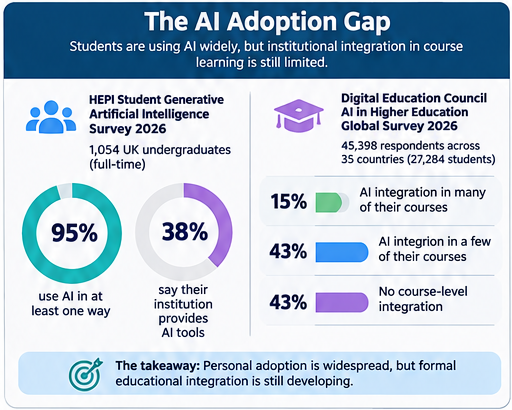
In the Student Generative Artificial Intelligence Survey 2026, published by the Higher Education Policy Institute (HEPI) with support from Kortext, 95% of 1,054 surveyed full-time U.K. undergraduates reported using AI in at least one way. Yet only 38% said their institution provided AI tools, highlighting a gap between students' use of the technology and the support available through their universities.
The figures raise a question universities cannot afford to overlook: Are students using AI to understand their subjects better, or mainly to finish assignments faster?
That difference will matter in 2027. AI can help students make sense of difficult concepts, practice unfamiliar skills, access course materials, and find answers to routine questions. But easier access to information is not the same as better learning. Students can still accept incorrect answers, become dependent on generated work, or cross academic integrity boundaries they do not fully understand.
For universities, the challenge is to make AI useful without allowing it to take over the thinking students need to do themselves. The decisions institutions make about teaching, assessment, and support will shape whether students graduate with stronger skills or simply greater familiarity with AI tools.
What Students Can Expect From AI in 2027
Students are already using AI, but that does not mean their courses have caught up. The gap between personal use and formal teaching is likely to shape their experience in 2027.
The Digital Education Council's AI in Higher Education Global Survey 2026 drew 45,398 responses across 35 countries, including 27,284 students and 18,114 faculty members. Among student respondents, only 15% reported AI integration in many of their courses. Another 43% encountered it in a few courses, while 43% reported no course-level integration.
The survey also found that just 29% of students considered their instructors well equipped to guide AI use. These findings suggest that access to technology is advancing faster than the instructional practices and faculty preparation needed to make it educationally valuable.
A student's experience in 2027 may depend as much on their course and institution as on the AI tools available. Some universities may offer structured tutoring, practice, and feedback within their learning platforms. Elsewhere, students may continue to turn to general-purpose chatbots on their own, with little connection to what happens in class.
The OECD's Digital Education Outlook 2026 examines generative AI in higher education and synthesizes emerging research showing that general-purpose tools can improve task performance without necessarily producing comparable learning gains. It distinguishes such applications from educational AI systems designed around specific learning objectives and established teaching principles.
The question for 2027 is therefore less about whether every university will introduce AI and more about what students will gain from it. Tools that help complete an assignment quickly are not necessarily the tools that help someone understand the subject.
5 Key Benefits of AI in Higher Education for Students
AI is most useful to students when it gives them more chances to ask questions, practice, receive feedback, and participate in learning. Whether those opportunities lead to better outcomes depends on how educators use the tools, not simply on how advanced the technology appears.
1. Personalized Learning and Academic Support
Students do not arrive at university with identical knowledge or confidence. In a large class, one explanation may make perfect sense to some students and leave others confused. Instructors cannot always provide individual help at the moment each student needs it.
AI-enabled tutoring systems can provide alternative explanations, generate practice questions, and adjust the level of support based on a learner's responses. A student struggling with a statistical concept, for example, might work through progressively more difficult problems while receiving feedback on each attempt.
Evidence suggests that instructional design makes a substantial difference. In a randomized crossover study published in Scientific Reports in 2025, researchers evaluated a purpose-built AI tutor in an introductory physics course for life-sciences students at Harvard University. The AI-tutored condition produced more than twice the median learning gains of the comparison condition involving in-class active learning, as measured by lesson-specific assessments.
These findings are promising, but they need context. The researchers tested a particular tutor in a particular physics course. The result does not mean that AI tutors outperform teachers in general or that every discipline would see the same gains.
For students, the opportunity lies in receiving additional, structured academic support without losing access to instructor guidance. Thoughtfully designed AI for students can provide additional explanations or opportunities for practice, while faculty remain responsible for educational objectives and instructional quality.
2. Greater Accessibility and Inclusion
For some students, accessing course material can be a challenge before the learning even begins. Captions, transcripts, translation, text-to-speech, and alternative formats can make lectures and readings easier to follow, particularly for students with disabilities or language-related barriers.
For example, a student who has difficulty following a recorded lecture may benefit from a searchable transcript. Another student may use text-to-speech to engage with a lengthy reading assignment or translation support to understand unfamiliar terminology before returning to the original material.
These capabilities do not automatically make educational content accessible. Automated captions can misinterpret technical terminology, translations can alter meaning, and AI-generated image descriptions may omit important information. Institutions must evaluate both the accessibility of the tools and the accuracy of their outputs.
AI for students can complement established accessibility practices when institutions test these technologies with the learners they are intended to support. Formal accommodations, accessible course design, and specialist assistance must remain available.
3. Faster Feedback and More Opportunities to Practice
Feedback is often most helpful while a student is still trying to solve a problem. By the time a marked assignment comes back, the student may have moved on, and the chance to correct a misunderstanding during the task has passed.
AI-supported formative assessment can provide preliminary responses to practice exercises, identify possible errors, and suggest areas for further study. In writing-intensive courses, for instance, students might receive guidance on argument structure or evidence gaps before submitting a draft for instructor review.
However, faster feedback is not necessarily better feedback. An automated system may overlook context, misinterpret a student's reasoning, or suggest corrections that conflict with course requirements. Its usefulness depends on sound assessment design and students' ability to question the feedback they receive.
Institutions exploring AI assessment tools for educators should distinguish low-stakes practice from high-stakes academic evaluation. AI can create additional opportunities for feedback, but students still need clear rubrics, instructor involvement, and reliable procedures for resolving disputed assessments.
4. Career Preparation and Workplace Skills
Graduates entering the workforce in 2027 may be expected to use AI for research, communication, analysis, coding, or other everyday tasks. Knowing how to produce an answer with a chatbot will not be enough. They will also need to judge whether that answer is useful, accurate, and appropriate for the work at hand.
The Digital Education Council's 2026 survey found that only 28% of students believed most or many of their assessments reflected the work, skills, and judgment they expected to need in an AI-enabled workplace. This raises questions about whether academic activities adequately prepare students to evaluate and improve AI-assisted work.
AI for college students can support career preparation through simulated professional scenarios, interview practice, research assistance, and opportunities to evaluate AI-generated outputs. A business student might assess the assumptions in an AI-produced market analysis, while an engineering student could test whether generated code meets functional and security requirements.
These activities should develop disciplinary expertise alongside technical familiarity. Students need to recognize unreliable outputs, explain their decisions, and remain accountable for the quality of their work.
As Straive LearningMate discusses in its article on AI-powered learning for career readiness, connecting academic experiences with workplace expectations requires applied skills and opportunities to demonstrate competence.
5. Better Access to Student Services
The higher education learner journey extends well beyond lectures and assignments. Registration, financial aid, advising, and access to campus services can all affect whether students stay on track. Confusing instructions or slow responses can be especially difficult for students balancing study with work or family responsibilities.
AI-enabled self-service systems can help students locate information, understand routine procedures, and identify the appropriate department for assistance. A student checking library hours or a registration deadline may benefit from an immediate response based on up-to-date institutional information.
Other requests require greater care. Financial aid eligibility, academic appeals, personal circumstances, and mental health concerns often depend on sensitive information or professional judgment. These matters should not be resolved solely through automated responses.
Straive LearningMate's discussion of AI self-service in higher education makes this distinction explicit. Effective support depends on matching the complexity and consequences of a request to the appropriate level of assistance, including a clear path to qualified staff when automated self-service is insufficient.
5 Major Challenges of AI for Students
The challenges of AI in education go beyond incorrect answers. Students also face inconsistent academic rules, pressure to rely on generated work, questions about privacy, and unequal access to tools. Universities need to address these problems without making legitimate uses of AI unnecessarily difficult.
1. Academic Integrity and Unclear Boundaries
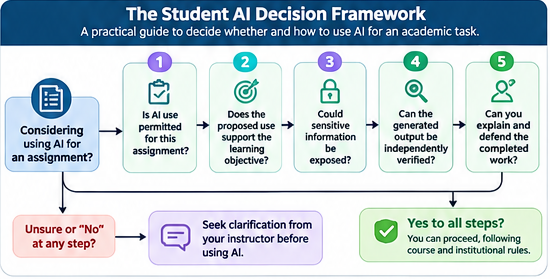
Students may encounter different rules for AI use across courses, departments, and instructors. One assignment may permit AI-assisted brainstorming, while another prohibits the use of generated text or requires detailed disclosure. Without clear guidance, students may struggle to distinguish acceptable assistance from academic misconduct.
The issue becomes particularly serious when institutions rely on automated AI detection tools to investigate suspected violations. Detection scores are probabilistic assessments, not definitive evidence of authorship. In a 2023 analysis published in Patterns, Liang and colleagues found that several AI detectors frequently misclassified writing by non-native English speakers as AI-generated. The findings raise concerns about the fairness of using detector results in academic investigations.
A false accusation can affect a student's academic record, confidence, and relationship with the institution. Universities therefore need fair procedures that consider the assignment, the student's work process, and other relevant evidence rather than treating a detector score as conclusive.
Clear expectations should be established before an assignment begins. Students need to know which forms of AI assistance are permitted, what must be disclosed, and how they can demonstrate their own contribution. Institutions should also provide accessible procedures for seeking clarification or challenging a finding of misconduct.
2. Overreliance on AI and Its Impact on Learning Skills
AI can make an assignment easier to finish without making the subject easier to understand. If students hand over the reading, analysis, writing, or problem-solving to a tool, they may miss the very practice the assignment was designed to provide.
For example, asking AI to explain an unfamiliar mathematical method can support understanding. Asking it to solve every problem without attempting the underlying reasoning may prevent the student from recognizing mistakes or applying the method independently.
This concern is consistent with the OECD's 2026 assessment of generative AI in education. The report emphasizes that educational use should develop human knowledge and skills rather than replace the cognitive effort involved in learning. It also distinguishes general-purpose AI tools from systems specifically designed around educational objectives.
The practical response is not to prohibit every form of AI assistance. Universities can combine AI-supported preparation with activities that require students to explain their reasoning, defend conclusions, apply concepts in unfamiliar situations, and demonstrate independent understanding. The key question is whether students can perform the underlying intellectual task when AI assistance is unavailable.
3. Accuracy, Bias, and Misinformation
A confident-sounding AI response can still be wrong. It may contain an invented reference, leave out an important qualification, rely on outdated information, or present a disputed interpretation as settled fact. Students who are new to a subject may find these errors especially hard to spot.
An AI-generated summary of a research paper, for instance, may omit methodological limitations or describe findings more confidently than the authors intended. A fabricated citation can appear plausible enough to enter an assignment unless the student checks the original publication.
Bias creates another challenge. AI outputs may reflect limitations in the training data, uneven representation of perspectives, or assumptions embedded in how a question is framed. These issues can affect academic research, case studies, and decisions involving social or cultural context.
Students therefore need to verify significant claims against reliable sources, examine original evidence, and distinguish generated explanations from established knowledge. Universities can reinforce these practices through assignments that ask learners to identify inaccuracies, compare sources, and explain why particular evidence is trustworthy.
4. Student Data Privacy and Security
AI-enabled learning systems may process student questions, written assignments, learning activity, and other information. Depending on the platform and its configuration, this raises questions about what data is collected, how long it is retained, who can access it, and whether it is used for purposes beyond the student's immediate request.
Students may not understand these arrangements, particularly when using consumer AI tools outside institutionally approved systems. Uploading identifiable records, unpublished research, confidential placement information, or sensitive personal details can create risks that are difficult to reverse.
Universities need clear rules governing approved tools, data handling, access permissions, vendor agreements, and retention practices. Privacy notices should explain these arrangements in language students can understand rather than relying exclusively on lengthy technical policies.
Practical guidance is equally important. Students should know which information requires protection, when institutional authorization is necessary, and where to seek advice about a tool's data practices. UNESCO's Guidance for Generative AI in Education and Research provides a broader framework for addressing data protection and human-centered governance in educational settings.
5. Unequal Access to AI Tools
Students do not all have the same devices, internet access, paid AI features, or support when something goes wrong. Differences in confidence and accessibility can make the gap wider, even when an institution recommends the same tool to everyone.
If an assignment assumes that students can access a particular AI system, those without comparable resources may face an unintended disadvantage. Even when a basic version is free, usage restrictions or differences in functionality may influence the assistance available.
Institutions should therefore consider access when designing AI-enabled activities. This includes providing approved tools where appropriate, maintaining accessible alternatives, and ensuring that students are not penalized for circumstances beyond their control.
Equity also involves the ability to use technology effectively. Students need training, clear expectations, and opportunities to seek assistance. Providing a license without developing these supporting conditions may leave existing differences in educational opportunity largely unchanged.
AI Literacy: Skills Students Need in 2027
AI literacy for students involves more than writing effective prompts. Students need to recognize when a tool is useful, understand its limitations, check its answers, and decide when doing the work themselves matters more.
The Digital Education Council's 2026 survey highlights the importance of critical evaluation and fact-checking, as well as knowing when AI should and should not be used. These priorities reflect a growing recognition that effective AI use depends on judgment rather than technical fluency alone.
Five capabilities deserve particular attention:
- Evaluating AI-generated information. Students should verify important claims, trace references to original sources, and recognize uncertainty or missing context.
- Using AI within academic rules. They need to understand assignment-specific permissions, disclosure requirements, authorship expectations, and institutional policies.
- Protecting sensitive information. Students should recognize privacy risks and understand the limits of approved platforms before sharing data.
- Applying discipline-specific judgment. AI literacy should reflect the requirements of different fields rather than relying exclusively on generic training.
- Knowing when to work independently. Students must identify situations where generating an answer would bypass the skill they are supposed to develop.
The fourth capability is particularly important. A nursing student evaluating an AI-generated clinical explanation needs to consider the quality of the evidence, safety, and professional responsibilities. A literature student examining an AI-generated interpretation must assess textual evidence, context, and competing readings. Both require critical thinking, but the standards used to evaluate the output differ.
The fifth capability is equally significant. Students should be able to explain not only how they used AI, but why they chose to use it for a particular task and what work they completed themselves.
UNESCO's AI Competency Framework for Students reinforces this broader understanding of AI literacy by emphasizing human-centered thinking, ethics, AI techniques and applications, and AI system design. These dimensions can help universities develop learning activities that go beyond familiarity with individual tools.
How Universities Can Support Responsible AI Use by Students
Students cannot be expected to follow AI rules consistently when those rules change from one course to another or are difficult to find. Clear guidance, suitable tools, and opportunities to ask questions are part of an institution's responsibility.
Institutions should establish clear, accessible policies that distinguish acceptable assistance from prohibited substitution. These policies need to be translated into assignment-level guidance because the appropriate role of AI varies across disciplines and learning objectives.
Faculty development is another priority because students need consistent, informed guidance across courses. Educators need opportunities to understand AI capabilities, evaluate risks, and redesign learning activities where necessary, particularly when assessment methods or institutional policies change.
Assessment practices should also evolve. Rather than relying exclusively on finished written submissions, universities can incorporate demonstrations, oral explanations, staged drafts, practical applications, and other methods that make student understanding visible.
Student participation matters throughout this process. Institutions should consult learners when designing student journey solutions, asking about accessibility, fairness, tool usability, privacy concerns, and the clarity of academic expectations. Policies developed without student input may overlook difficulties that emerge in everyday use.
Taken together, these measures can help students understand the boundaries of AI assistance and find reliable guidance when questions arise. Universities should also revisit their policies as tools, teaching practices, and student needs change, rather than treating initial guidance as permanent.
How to Measure AI's Impact on Student Learning and Experience
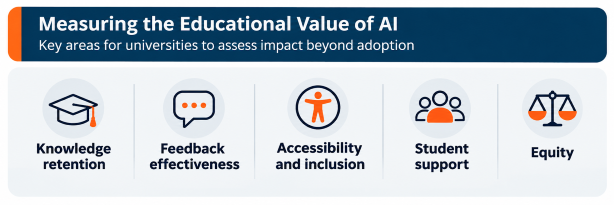
Counting AI users is easy. Measuring the impact of AI on higher education, particularly on learning and student services, is harder. Universities need evidence that students understand more, receive better support, or face fewer barriers, not just figures showing how often a tool was opened.
A meaningful evaluation framework should examine several dimensions:
- Learning outcomes: Are students demonstrating stronger understanding, retention, and independent application of knowledge?
- Feedback quality: Do students receive useful guidance that helps them improve subsequent work?
- Accessibility and inclusion: Are students with different needs able to participate more effectively?
- Student support: Are routine requests resolved accurately, and do complex cases reach qualified staff without unnecessary delays?
- Equity: Are benefits distributed fairly across student groups, courses, and levels of digital access?
- Trust and confidence: Do students understand institutional AI policies and feel able to question automated outputs or decisions?
Institutions should establish baseline measures before introducing new systems and compare results over time. Where feasible, evaluations should use appropriate comparison groups, examine differences across student populations, and account for other factors that may influence outcomes.
Student feedback matters, but convenience is not proof of learning. Students may enjoy a tool that saves time without gaining a deeper understanding of the subject. An activity that requires more effort may sometimes teach them more.
These differences matter when universities decide where to invest. Usage figures show whether students have adopted a tool; learning outcomes, fairness, and the quality of support show whether it has been worthwhile.
How Straive LearningMate Supports AI-Enabled Learning and Student Success
Choosing an AI chatbot is only one part of supporting students. Universities also need course materials, assessments, institutional data, and student services to work together so that the technology supports what educators are trying to achieve.
Straive LearningMate provides education-focused technology, content, and AI services. Its published AI solutions for education cover areas including AI-enabled curriculum development, assessment, personalized learning, AI-readiness consulting, and governance.
These capabilities address different aspects of the student experience. AI-supported assessment and AI content tools for educators can help institutions develop and maintain learning resources and practice activities. Their educational value depends on how those resources align with course objectives, accessibility requirements, and faculty review processes.
Straive LearningMate also examines how AI can support students throughout the higher education learner journey, from initial engagement and enrollment to learning, support, and ongoing relationships with institutions.
Its published student journey solutions explore how institutions can connect these experiences across academic and administrative systems. The emphasis is on coordinated support rather than treating each interaction as an isolated technology use case.
Student support is an important part of this approach. Straive LearningMate's framework for AI-powered student support operations distinguishes routine self-service interactions from requests that need staff assistance or specialist intervention.
The relevance for students is practical. A connected learning environment should help them find reliable information, receive appropriate academic support, and navigate institutional processes without losing access to qualified people when their circumstances require individual attention.
These published services and frameworks illustrate possible approaches to AI-enabled education rather than evidence of results in every institutional context. Their effectiveness should be assessed through implementation quality, student feedback, accessibility, and measurable learning and service outcomes.
Conclusion
The question for 2027 is no longer whether students will encounter AI during their studies. Many already use it. Universities now need to determine whether that use helps students learn, gives them fair access to support, and prepares them for work beyond graduation.
Well-designed tools can give students more opportunities to practice, ask questions, receive feedback, and get timely help. But if students rely on generated answers instead of working through ideas themselves, the same tools can leave important gaps in their understanding.
The strongest test of an AI initiative is what students can explain, apply, and accomplish without leaning on the tool. That matters more than how quickly they finish a task or how many AI features a university introduces.
FAQs
AI can provide personalized explanations, additional practice, faster formative feedback, accessibility support, career preparation activities, and easier access to routine student services. These benefits depend on appropriate instructional design, reliable information, and opportunities for students to demonstrate their own understanding.
References
- Stephenson, R., & Armstrong, C. (2026). Student Generative Artificial Intelligence Survey 2026. Higher Education Policy Institute, Report 199. Sponsored by Kortext.
- Digital Education Council. (2026). AI in Higher Education Global Survey 2026.
- OECD. (2026). OECD Digital Education Outlook 2026: Exploring Effective Uses of Generative AI in Education.
- Kestin, G., et al. (2025). AI tutoring outperforms in-class active learning: An RCT introducing a novel research-based design in an authentic educational setting. Scientific Reports, 15, Article 17458.
- Liang, W., et al. (2023). GPT detectors are biased against non-native English writers. Patterns, 4(7), 100779.
- UNESCO. (2023). Guidance for Generative AI in Education and Research.
- UNESCO. (2024). AI Competency Framework for Students.
About the Author

SVP, Advanced Digital Solutions
A results-driven professional with comprehensive experience working in global and cross-cultural environments. Possesses extensive experience in F&A operations, customer relations, financial, market and economic analysis, and advisory services, complemented by a strong educational foundation. Demonstrates expertise in establishing productive relationships with diverse clients by driving operational rigor and excellence, supported by process improvements and efficiency gains, along with a proven record of successfully leading multiple and diverse engagements.
Share with Friends:






Related Insights
From industry research to thought-provoking articles and podcasts, we bring you insights into our fast-evolving world of education technology. Come learn and evolve with us.
We discuss the paradox students face when using generative AI tools like ChatGPT, and how educators can foster authentic learning experiences in an AI-driven world.
Read More
Through our work impacting 10 million learners nationwide with innovative K-12 and Higher Education solutions, we bring insights from the front lines of digital education.
Read More
GCCs have reputation for efficiency, and they’re quickly becoming a business advantage in the EdTech industry where speed defines success.
Read MoreLet's have a conversation...
For over twenty years, LearningMate has been leading the charge in large-scale education technology innovation. To learn more about our AI-enabled solutions and our human-in-the-loop approach to AI, contact us.

